
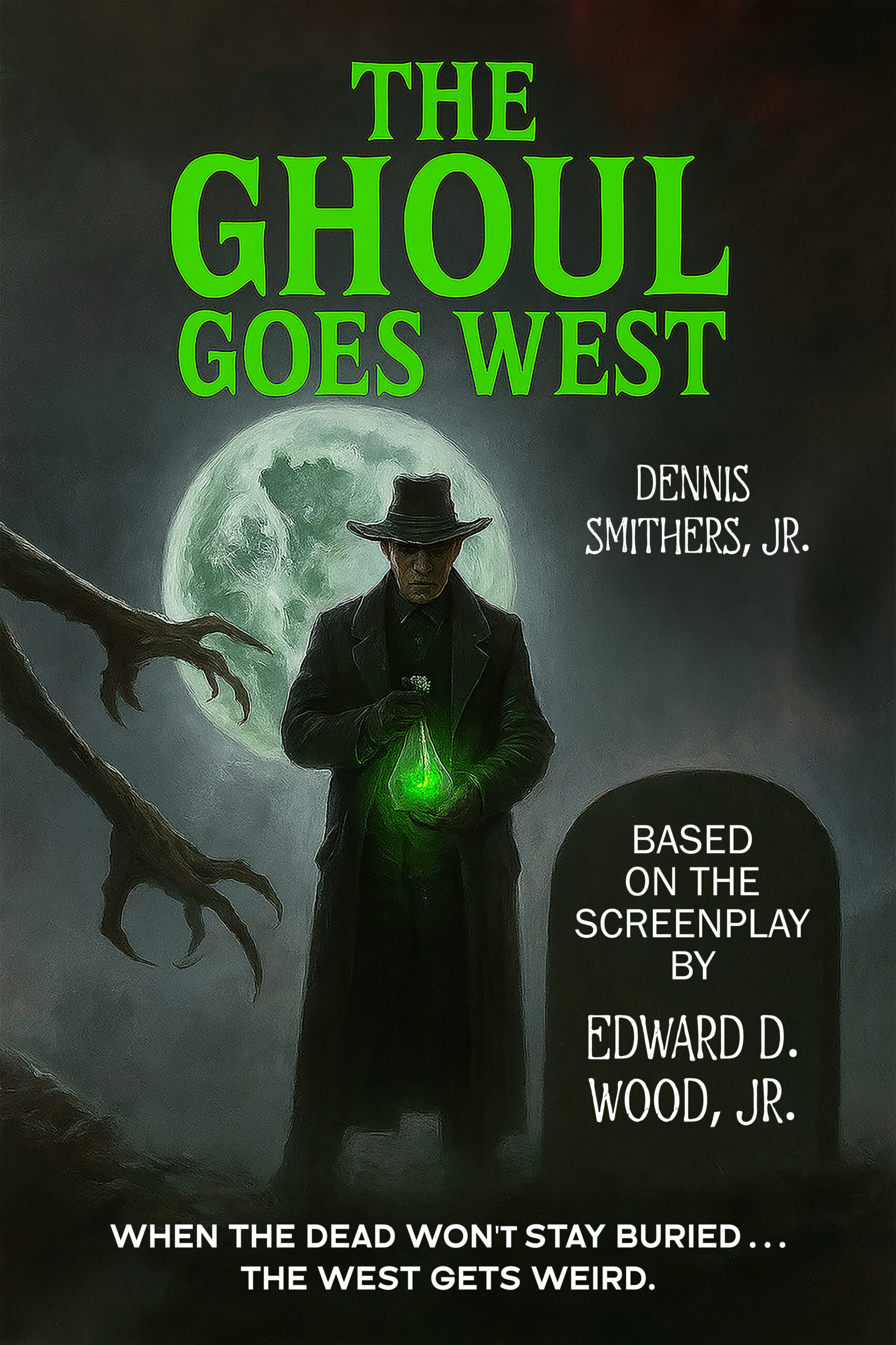
Ed Wood’s most famous unproduced screenplay is reborn as a horror-western pulp novel!
In the dust-choked town of Pumpkin’s Promise, the dead don’t stay buried. Graves are robbed beneath moonlight, black horses drag coffins into the hills, and the sound of a ghostly organ drifts on the wind.
Sheriff Chance Hilton rides into a nightmare of towering undead ghouls, a kidnapped sweetheart, and an undertaker whose experiments blur the line between man and monster.
Equal parts Gothic Horror and six-gun Western, The Ghoul Goes West resurrects Ed Wood’s legendary lost tale with a vengeance. A pulp fever-dream of graveyards and gunfights, mad science and frontier justice—a drive-in classic finally unleashed on the page.
Click here to purchase on Amazon.
FOREWORD by Joe Blevins
Nobody can write like Edward Davis Wood, Jr. Many have tried, including me, but no author has yet managed to replicate the curiously mangled syntax of Eddie’s writing. Fueled by rotgut booze and his own unfettered imagination, the man from Poughkeepsie could string words, phrases, and ideas together in a way that was unique and unmistakable. Ed’s plots unfold like fever dreams, each sentence a beautiful little catastrophe unto itself. He was a natural. The Ed Wood imitators, affectionate as they are, always seem self-conscious, mannered, and more than a little condescending. It never works.
Luckily, in adapting Ed’s infamous unfilmed screenplay The Ghoul Goes West as a two-fisted pulp novel, author Dennis Smithers, Jr. avoids the usual pitfalls of Wood wannabes. He doesn’t need to write like Ed Wood because he has a strong and assured authorial cadence of his very own. You’ll soon find that out as you make your way through these punchy, action-packed chapters. Boy, are you going to have fun!
So what do we have here? Well, in the early-to-mid-1950s, Ed Wood kept toiling away on a potential film project titled The Phantom Ghoul or The Ghoul Goes West. It was supposed to be a combination of two genres near to his heart, cheap horror and cheaper Western, and it would have starred Gene Autry and Bela Lugosi. (Guess which one was the hero and which the villain.) You can read all about it in a marvelous book called Ed Wood and the Lost Lugosi Screenplays (2016) by Gary D. Rhodes. If that volume has somehow eluded you until now, track it down immediately.
The plot . . . oh dear God, how do I describe this thing? See, there’s this sheriff named Chance Hilton who presides over an Old West mining town called Pumpkin’s Promise. Like any good Saturday matinee hero, he’s so honest and trustworthy that you could set your watch to him. Naturally, he has a best gal, Nancy, but the local saloon owner, Melody, is sweet on him, too. It’s a whole thing. Every good guy needs his bad guy, and Chance’s hissable nemesis is a sinister, black-clad newcomer to the town named Professor Smoke. This eerie intruder serves as the undertaker in Pumpkin’s Promise (can you imagine Bela Lugosi saying that name out loud?), but it’s just a front for his real work, which he carries out in an abandoned mineshaft. Did I mention there have been some grave robbing in town recently? Sounds like someone is tampering in God’s domain. Chance has a rather outrageous plan for getting to the bottom of all this, and it’s fair to say that the plan both works and doesn’t work.
For a variety of reasons, not least of which was Lugosi’s inconvenient death in 1956, Ghoul never went before the cameras. It’s one of Eddie’s many unrealized projects, but it just may be the most famous of all his orphans. The ill-fated film is even name-checked in Tim Burton’s Ed Wood (1994) during a scene in which young, ambitious Eddie (Johnny Depp) pitches potential movies to a highly skeptical executive, Mr. Feldman (Stanley DeSantis) at Warner Bros. Needless to say, the idea of a ghoul going West does not wow Feldman, and Eddie determinedly moves on to other projects. In real life, Ed Wood also had to move on from this beloved script, which he’d planned to make in widescreen 3D.
But now, many decades later, Dennis has distilled The Ghoul Goes West into a rip-roaring novel. And so, in this format, the story can finally play out on the widest screen imaginable: the one inside our minds. No 3D glasses required. In translating this story into prose, the author has demonstrated a great gift for sensory description. Reading this novel, then, is like seeing the movie in a newly restored high-definition transfer. What a gift. You’re gonna love it.
Click here to purchase on Amazon.